MPPI Wheeled Quadruped
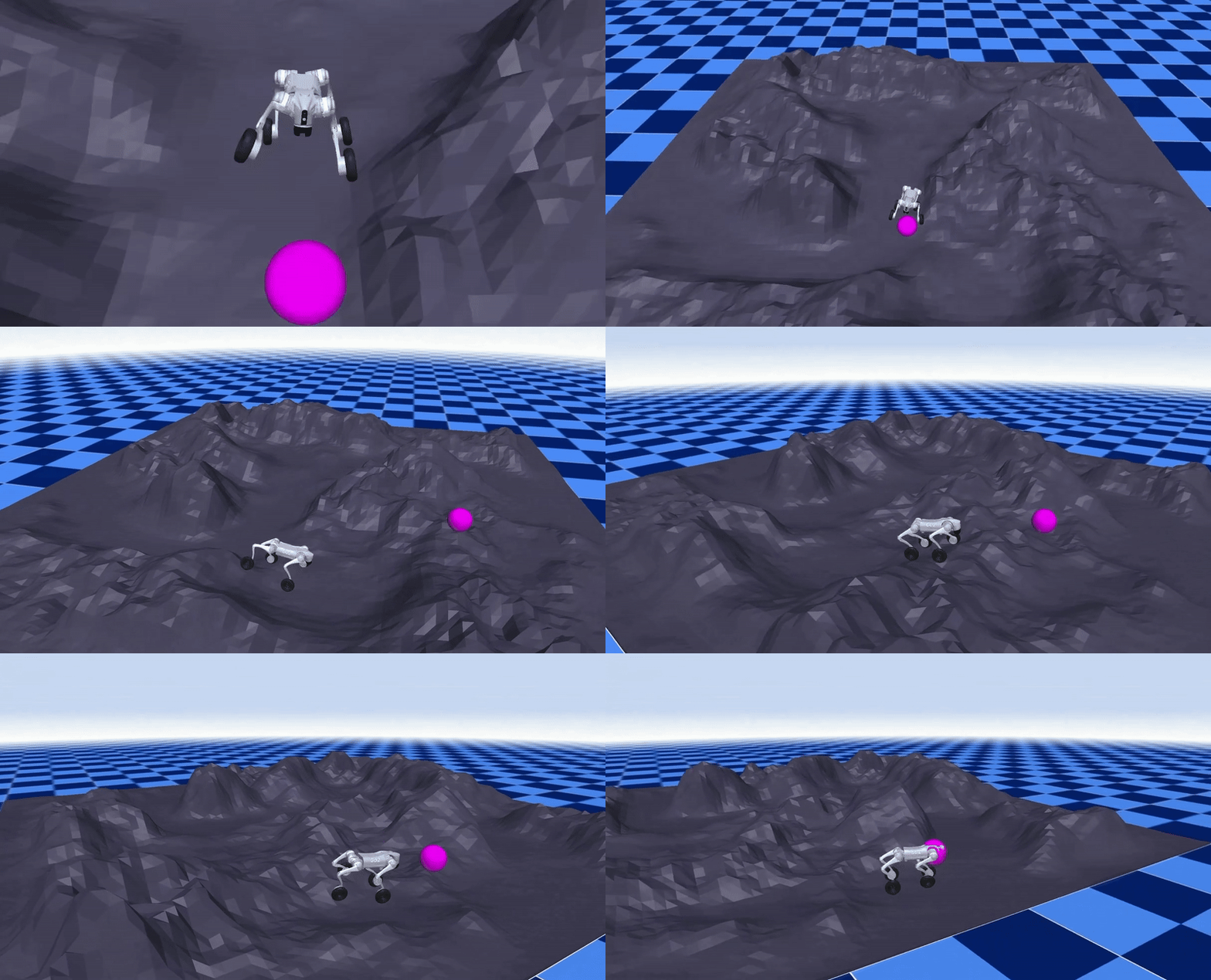
I built this project around a control question that comes up with wheeled-legged robots: can one sampling-based controller handle both stepping and rolling without switching to a separate planner? I adapted a real-time whole-body Model Predictive Path Integral controller for the Unitree Go2W in MuJoCo, starting from a legged quadruped MPPI baseline and expanding it for hybrid locomotion.
The controller adds four wheel-torque channels to the action space, augments the running cost with wheel-velocity regulation, a PD-shaped joint-effort penalty, and an L1 base positional drift penalty, and modifies the Raibert-style foot-placement heuristic to account for wheel speed. I wanted MPPI to remain the single control layer across walking, rolling, jumping, and stair-climbing tasks, without offline learning or precomputed contact schedules.
Simulation tasks include walk_straight, roll_straight, walk_octagon, big_box, and stairs, with task definitions covering goal positions, commanded body-frame velocities, gait phases, waiting times, MuJoCo model paths, and controller YAML configs. In the rough-terrain comparison, the wheel-aware controller reduces traversal time by 55.7% and raises forward velocity by 134.5% over the leg-only baseline while maintaining smoother wheel-ground contact.
Sources I leaned on: Williams et al. on information-theoretic MPPI; Theodorou, Buchli, and Schaal on path-integral control; Raibert’s legged-robot foot-placement heuristics; and recent wheeled-legged locomotion work on hybrid contact and wheel torque control.
Technical stack: Python, MuJoCo 3.1.6, NumPy, SciPy, Matplotlib, mujoco-python-viewer, editable setuptools package.
Keywords: whole-body MPPI, Model Predictive Path Integral control, sampling-based MPC, Unitree Go2W, wheeled-legged robot, hybrid locomotion, wheel-torque control, Raibert heuristic, gait scheduler, MuJoCo simulation, rough terrain, stair climbing, box jump, waypoint following.
