Sampling Based Planners
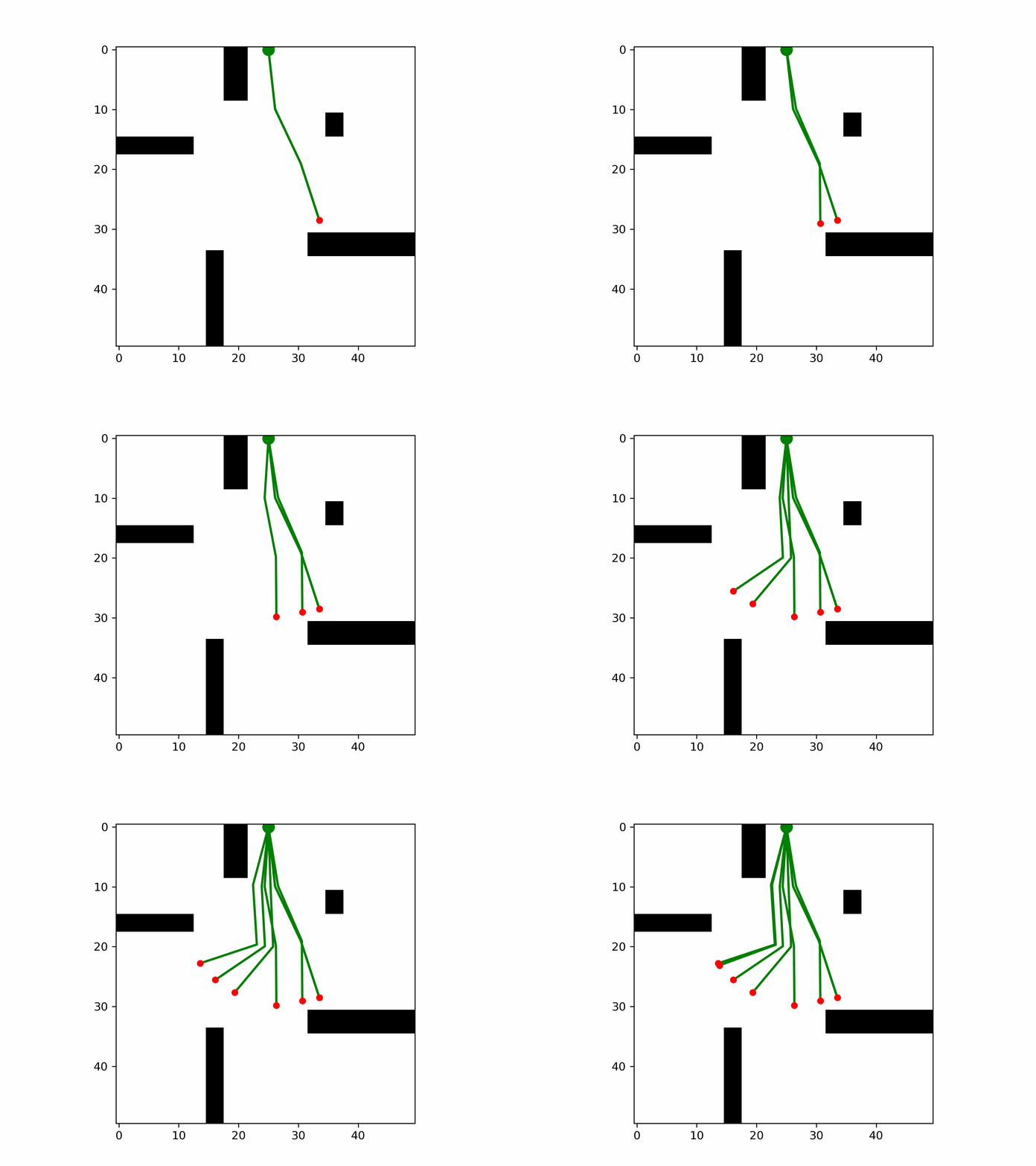
I used this project to compare how different sampling-based planners behave on the same high-DOF arm problem. The planner executable receives an occupancy-grid map, the arm DOF count, comma-separated start and goal joint angles, a planner ID, and an output path, then returns a collision-free sequence of joint configurations for a planar arm with fixed 10-cell links.
The important idea is that planning happens in configuration space even though collision is checked in workspace. For each candidate joint vector, I rasterize every link with Bresenham line traversal, reject poses that hit nonzero map cells, sample joint angles in [0, 2*pi), and score path quality as cumulative wrap-around L1 joint motion.
The planner modes show the tradeoff nicely. Single-tree RRT is simple and usually finds something. RRT-Connect grows start and goal trees toward shared samples and is much faster for single-query planning. RRT* adds local rewiring, which can lower cost but spends more time improving the tree. PRM pays an upfront roadmap cost, then uses Dijkstra search over collision-checked graph edges.
In my report, I compare fixed start/goal pairs over 3-, 4-, and 5-DOF settings on map2.txt. RRT-Connect was the fastest and most reliable single-query planner overall, RRT* reduced path cost through rewiring at higher runtime, and PRM produced strong global path quality but paid a larger roadmap construction cost.
Sources I leaned on: Kavraki et al. on probabilistic roadmaps; LaValle’s original RRT work; Kuffner and LaValle’s RRT-Connect paper; and Karaman and Frazzoli’s RRT* optimality result.
Technical stack: C++, CMake, Python, Matplotlib, Pillow, occupancy-grid maps, CSV evaluation outputs.
Keywords: sampling-based motion planning, high-DOF arm planning, planar robot arm, configuration space, collision checking, Bresenham rasterization, occupancy grid, RRT, RRT-Connect, RRT*, PRM, roadmap planning, Dijkstra search, goal bias, nearest-neighbor search, rewiring, path quality, wrap-around joint cost, C++, CMake, Python visualization.
