DeformX: A Versatile Co-Simulation Framework for Deformable Linear Objects

DeformX: A Versatile Co-Simulation Framework for Deformable Linear Objects

Jun 29, 2026·
Yi Yang
,
Xiang Fei
,
Lehong Wang
,
Chenhao Li
,
Zilin Dai
Henry Kou
Henry Kou
,
Lu Li
,
Howie Choset
· 2 min read
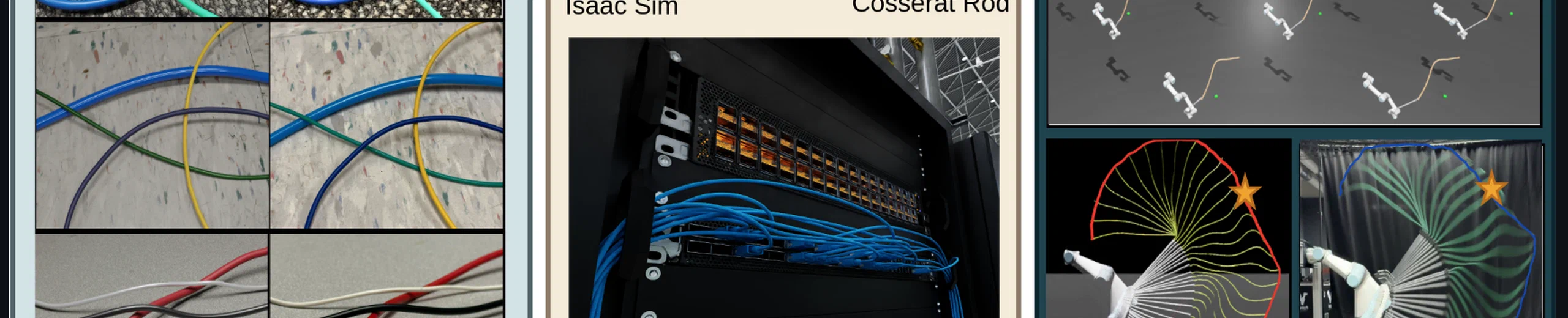
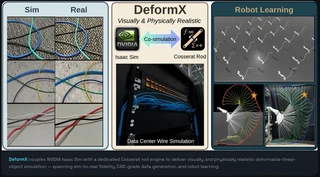
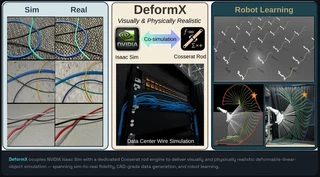
DeformX co-simulation framework for deformable linear objects.
Abstract
Deformable linear objects (DLOs) such as wires, cables, and ropes are common in robotic manipulation tasks, yet simulating them with both visual realism and physical accuracy remains challenging. Existing visual simulation methods typically rely on procedural geometric primitives that lack physically grounded deformation behavior, while physics-based approaches with robot learning support often approximate DLOs as rigid-link chains or generic soft bodies, failing to accurately capture the bending, twisting, and shear mechanics of slender elastic structures. In this work, we introduce DeformX, a co-simulation framework that integrates a dedicated Cosserat rod physics engine with NVIDIA Isaac Sim, enabling DLO simulations that are both physically faithful and visually realistic. Our Cosserat rod engine simulates the dynamics and self-collisions of DLOs, and contact interactions with arbitrary free-form meshes. To achieve high-fidelity visualization, we employ mesh skinning to map discrete rod deformations onto imported CAD models. To the best of our knowledge, DeformX is the one of the first frameworks for DLO simulation that unifies realistic visualization, principled physics, and compatibility with robot learning pipelines. We demonstrate its versatility across synthetic data generation and policy learning for DLO manipulation, and validate visual and physical fidelity through comparisons against real-world experiments. Notably, fine-tuning Segment Anything Model 3 (SAM3) on DeformX-generated data yields a 10.2% mAP@75 improvement in real-image wire segmentation, and a rope-swinging policy trained entirely in DeformX achieves a mean target-hitting error of 6.6 cm on a UR5e manipulator in real-world trials, highlighting its strong sim-to-real transfer capability.
Type
Publication
2026 IEEE/RSJ International Conference on Intelligent Robots and Systems (IROS)
publications

DeformX co-simulation framework cover

DeformX is a co-simulation framework for deformable linear objects such as wires, cables, and ropes. The project addresses a common gap in robotic manipulation simulation: visually realistic DLO assets are often procedural and physically shallow, while physics-oriented approaches can simplify slender elastic objects into rigid-link chains or generic soft bodies that miss bending, twisting, and shear behavior.

The framework integrates a dedicated Cosserat rod physics engine with NVIDIA Isaac Sim. The rod engine simulates DLO dynamics, self-collisions, and contact with arbitrary free-form meshes, while mesh skinning maps discrete rod deformation onto imported CAD models for high-fidelity visualization. This combination is intended to support both realistic visual rendering and principled physics in robot-learning pipelines.

The paper demonstrates DeformX across synthetic data generation and policy learning for DLO manipulation, then validates visual and physical fidelity against real-world experiments. Fine-tuning Segment Anything Model 3 on DeformX-generated data improves real-image wire segmentation by 10.2% mAP@75, and a rope-swinging policy trained entirely in DeformX reaches a mean target-hitting error of 6.6 cm on a UR5e manipulator in real-world trials.

Rope-swinging policy trained in DeformX executing target-hitting trials on a UR5e manipulator.

See the DeformX project website and the arXiv paper. The paper was accepted to IROS 2026.

Keywords: DeformX, deformable linear objects, DLO simulation, Cosserat rods, NVIDIA Isaac Sim, mesh skinning, robot manipulation, synthetic data generation, policy learning, sim-to-real transfer, SAM3, UR5e.

@inproceedings{yang2026deformx,
  title        = {DeformX: A Versatile Co-Simulation Framework for
                  Deformable Linear Objects},
  author       = {Yang, Yi and Fei, Xiang and Wang, Lehong and Li, Chenhao
                  and Dai, Zilin and Kou, Henry and Li, Lu and Choset, Howie},
  booktitle    = {2026 IEEE/RSJ International Conference on Intelligent
                  Robots and Systems (IROS)},
  year         = {2026},
  organization = {IEEE}
}
Henry Kou
Authors
Henry Kou (he/him)
MS Robotics Student and Research Associate
I am an MS Robotics student at Carnegie Mellon University with a background in electrical and computer engineering and a focus on state estimation, control theory, motion planning, and embedded robotic systems. As a research associate in the Biorobotics Lab, I work on building reliable, sensor-driven robots that connect theory with hardware and real-world autonomy.